Community workCusco, Peru
Community-governed systems in Peru.
Research and practical development with local collaborators, focused on communication, records and meaningful human control.
El Hilo que Persiste is a research programme developed at LAAD, a research lab at the Universidad Nacional de San Antonio Abad del Cusco (UNSAAC), in collaboration with me. LAAD’s involvement isn’t an endorsement of Higher Self’s commercial services.
The field test in detailField report, in Spanishhilopersiste.pe
The problem
On trails in the high Andes there’s often no mobile signal.
When someone needs help, there may be no reliable way to call for it, and no shared record of what happened or who responded. So I designed and built a deliberately small prototype.
- On the trailAn app to send a call for help.
- Long-range radioAcross the hillside, with no internet or mobile signal.
- The baseIts own local network, and an append-only case log.
- In the villageA bell, and an app to answer the call.
Nothing depends on the internet, a mobile network or a server someone else owns.
What the first test showed
The bell rang. The day taught us more about people than radio.
Worked
- A simulated call for help crossed the hillside by radio, reached the base and was logged, and the bell rang.
Not yet
- The bell wasn’t loud enough to wake someone asleep at night, in the cold.
- A responder who left the app couldn’t get back in while the alarm kept ringing.
- The node’s clock ran ten days behind. The log kept the order of events, not their time.
Every request the community made was about being able to act, not just to read: see which cases are being handled, tell cases apart, and say “I’m handling this one”.
Who was there
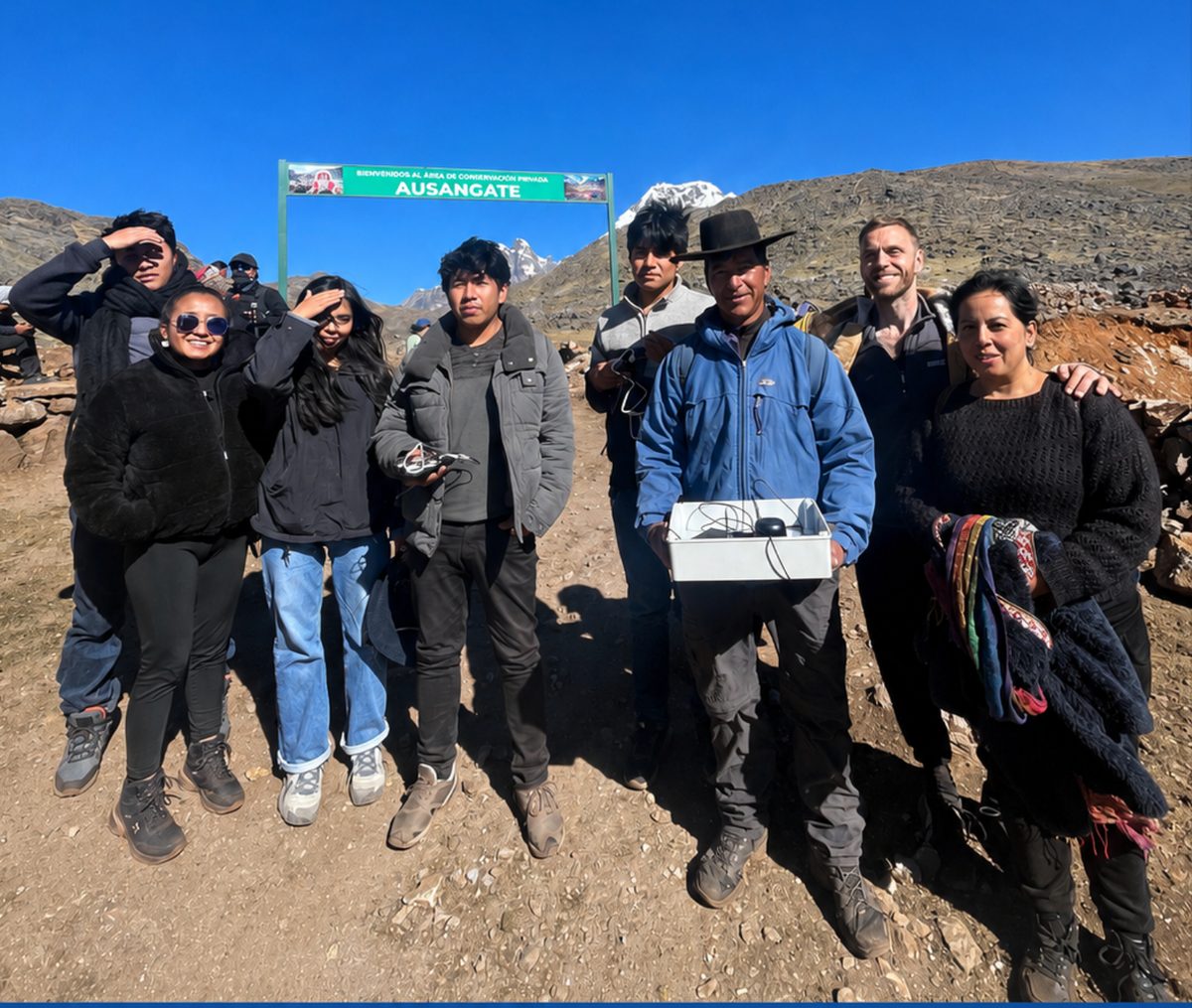
Five UNSAAC students
In engineering, informatics and anthropology, as independent auditors, to check whether what we said was true.
Orietta Trebejo
Coordinated the fieldwork and the relationship with the community.
David Bentley
Designed and built the prototype: the radio links, the offline base, the app, the case log and the bell.
“Today we install nothing.”
That’s how our letter of intent to the community begins. It was written to be read aloud, so the assembly could decide with the whole picture in front of it.
If the community goes ahead, the name, the data, the keys and the decisions would be theirs. The assembly reviewed the project and agreed to go ahead with the next stage.
From the rules to the field
The rules were written and published before anything went up the mountain.
Working papers and draft standards, in Spanish, published openly. None has yet been peer-reviewed or independently checked against the prototype.
- December 2025
Framework Protocol for decentralised infrastructure in Indigenous territories
The ethical base: free, prior, informed and continuing consent.
- January 2026
Reciprocal Intelligence (v0.1)
The governance standard: community authority as a technical requirement.
- January 2026
IR v1.0, public summary
The technical base for offline-first hardware.
- February 2026
Sovereign Khipu Protocol (PKS v1.1)
The evidence protocol: tamper-evident, append-only records.
- March 2026
PNT, Par Nodo Tinkuy
The custody model: two separately held nodes, reconciled in person.
- July 2026
The first field test
About 4,300 metres in the Cusco region. The call crossed the hillside and the bell rang.
- August 2026
Between the specification and the deployment
The field report: what we prepared, what happened, and what changes next.
- Next
Mapping the area on foot, with the community
With the assembly’s approval, then a production design back to the assembly before anything is built.
How this relates to my client work.
This is research, not a commercial service. It shares principles with my client work, but its audiences, relationships and measures of success are different.
Any commercial work with a research partner would be a separate written agreement, disclosed to everyone involved.
Working with communities or in research?
Write about offline infrastructure, community-governed data or field research.